
Cargo elevator maintenance needs to be scheduled before warehouse operations are disrupted. In 2026, new landed property supply in HCMC only reached 74 units in the first half of the year, while primary apartment prices in Hanoi continue to remain high, leading developers to prioritize extending equipment life instead of replacement. This article helps you identify faults, schedule maintenance, and control safety maintenance costs.
When should you perform cargo elevator maintenance instead of waiting for a breakdown to repair?
A cargo elevator should not be viewed as equipment that is only repaired when it stops running. Every unexpected shutdown can break the delivery chain, increase the risk of goods damage, and extend technical waiting times. For continuously operating facilities, cargo elevator maintenance is a risk management measure, not an incidental expense.

Signs to check immediately when the cargo elevator runs slowly, vibrates, or makes unusual noises
Elevators running slower than normal, vibrating during a segment of the travel, or emitting prolonged metallic sounds should all be noted. The cause may lie in unlubricated rails, worn pulleys, uneven hoisting cables, or an unstable control inverter. Do not increase the load to “test again”, as this action can worsen the fault.
Warning signs when landing doors, the cabin, or safety sensors operate unstably
Landing doors closing slowly, reversing multiple times, or the cabin not leveling correctly are signs that need to be addressed. Sensors that are dusty, misaligned, or have loose signal wires often cause intermittent errors. According to EN 81-20 and EN 81-50, design, installation safety requirements and elevator component testing must be controlled synchronously.
Cost risks when delaying cargo elevator maintenance in warehouses and restaurants
Delaying cargo elevator maintenance often turns a small fault into a major replacement item. Dry rails can wear out guide shoes. Misaligned landing doors can damage door locks. An emergency repair shift after hours usually costs more than routine inspections due to the need for rapid deployment of personnel and parts.
Situations to call for emergency cargo elevator repair instead of self-handling
Immediately stop the equipment and call for cargo elevator repair when there is a burning smell, continuous circuit breaker tripping, significant cabin misalignment, abnormal signs on cables, or if the door cannot be locked. Operators should only isolate the area, hang warnings, and record the error code. Absolutely do not open the control cabinet or interfere with the mechanical brake.
- Record the time vibration occurs so the technician can compare it with the load cycle and operation log.
- Take photos of the error display panel before cutting the power to avoid losing important diagnostic data.
- Stop transporting goods when the cabin does not stop level with the floor, even if the misalignment seems small.
- Do not use objects to jam the landing door as it can damage the safety interlock.
- Compare actual cargo load with the rated load written on the cabin parameter plate.
| Signs | Main Risk | Handling Level | Appropriate Action |
|---|---|---|---|
| Light vibration by section | Rail or guide shoes | Short-term monitoring | Schedule inspection |
| Door reverses continuously | Sensor or door lock | Needs early handling | Temporarily reduce usage frequency |
| Burning smell, breaker trips | Control electronics | Emergency | Stop machine immediately |
| Cabin misaligned | Brake or floor signal | Emergency | Isolate elevator |
Practical tip: set error notification thresholds into three levels: monitor, handle within the day, and emergency stop. This method helps warehouse management not equate a small noise with a dangerous fault, while still avoiding missed warnings.
Cargo elevator maintenance schedule based on actual operating frequency
The maintenance schedule must be based on the number of runs, actual load, and working environment. Dusty warehouses, restaurants with high humidity, or areas with a lot of grease require tighter inspection cycles. There is no one-size-fits-all schedule for every project.

Monthly maintenance schedule for cargo elevators operating continuously in warehouses
Thang vận hành nhiều ca nên được kiểm tra hằng tháng. Trọng tâm là vệ sinh tủ điện, đo tình trạng tiếp điểm, kiểm tra độ căng cáp, cửa tầng và độ phẳng điểm dừng. Dựa trên kinh nghiệm thi công của Thang Máy Việt Ý, kho có từ 100 lượt chạy mỗi ngày nên ghi số lượt vận hành, thay vì chỉ ghi ngày bảo dưỡng.
Quarterly inspection schedule for food lifts, motorcycle lifts, and light-duty lifts
Light-duty lifts can be checked quarterly when the number of runs is low and the environment is clean. However, food lifts need to focus on hygiene, as debris can affect door switches and sensors. Motorcycle lifts must have rails, doors, and load capacity reviewed more closely due to the high inertia of the cargo.
When to perform additional maintenance after peak production or changes in usage load
Additional maintenance should be performed immediately after peak periods or when changing the type of goods. For example, a Binh Duong warehouse switched from cardboard boxes to 420kg metal component clusters per trip. After two weeks, technicians discovered that guide shoes were wearing faster than expected. Early inspection helps avoid rail damage and reduces downtime.
How to keep an error tracking log so as not to miss the cargo elevator maintenance cycle
The logbook should have the date, operating shift, estimated load, error location, error code, recorder, and handling direction. Do not just write “elevator is noisy”. The description needs to clearly state if the noise occurs when going up, down, empty, or loaded. This data helps technicians pinpoint faults faster.
- Record the number of runs per shift to adjust the maintenance schedule according to actual usage intensity.
- Mark trips near the rated load to identify repeated overloading risks.
- Save control cabinet error codes along with photos to avoid subjective descriptions from operators.
- Statistically track landing door errors separately as this is the group of errors that most often causes downtime.
- Compare errors occurring after peak production periods or changes in cargo type.
| Elevator Group | Reference frequency | Focus of Inspection | Conditions for shortening cycle |
|---|---|---|---|
| Continuously operating warehouse | Monthly | Cables, brakes, doors, control cabinet | High dust, high load |
| Food lift | Monthly or quarterly | Hygiene, doors, sensors | Moisture, grease |
| Motorcycle lift | Monthly | Rails, cabin floor, doors | High dynamic load |
| Light-duty lift | Quarterly | Control electronics, doors | Sudden frequency increase |
Practical tip: do not just sign the report according to the schedule. Ask the technician to clearly record the estimated number of runs, common load levels, and parts prone to wear so that the next cycle has a basis for adjustment.
What are the steps in the cargo elevator maintenance process at a project site?
A proper process must start with assessing the current state, not by opening the control cabinet immediately. An elevator with the same load capacity but different stop points, environment, and door type will have different risks. Effective cargo elevator maintenance requires checking mechanics, control electronics, and operating conditions.
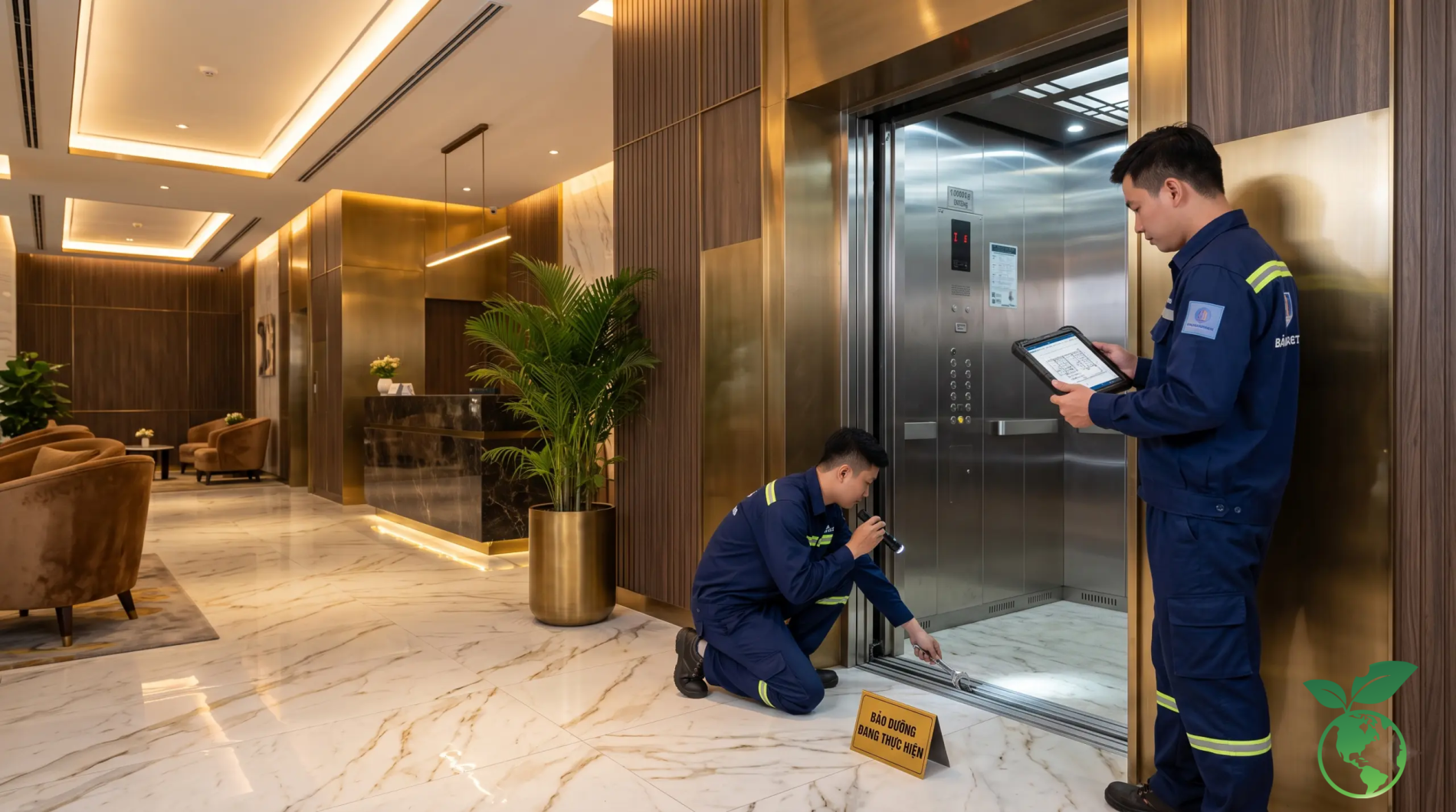
Pre-maintenance survey step: check load, usage frequency, and incident history
Technicians need to confirm the rated load, number of floors, type of goods, number of runs, and recurring faults. For example, a restaurant in District 1 uses a 100kg food lift for the basement and third-floor kitchen. Recurring door faults after peak hours show the cause is related to oily vapor, not just the door motor.
Mechanical inspection step: guide rails, hoisting cables, pulleys, cabin, and landing door system
Mechanical parts include rails, guide shoes, cables, pulleys, brakes, cabin floors, and interlocks. Technicians must evaluate actual wear, not just lubricate. With traction cable equipment, observe the uniformity of the cables and pulley surfaces. With hydraulic solutions, check for oil leaks and cylinder condition.
Control electronics inspection step: control cabinet, inverter, contactor, sensors, and floor call buttons
The control cabinet needs to be cleaned and connections checked. The speed control inverter needs to have its error log and thermal status viewed. Contactors, door sensors, and call buttons must have their signals checked. QCVN 25:2026/BCT on electrical safety comes into effect on August 8, 2026, so the power supply and electrical protection must be carefully reviewed.
Post-maintenance test run: measure smoothness, check floor stopping and test safety devices
Chạy thử phải gồm không tải và tải đại diện. Kỹ thuật kiểm tra độ êm, độ chính xác dừng tầng, phản hồi cửa, bộ cứu hộ tự động (ARD) và các tín hiệu cảnh báo. Thang Máy Việt Ý khuyến nghị chỉ bàn giao khi kết quả thử phù hợp tải hàng thực tế, không chỉ dựa trên một lượt chạy cabin rỗng.
Post-maintenance handover: report status, handled items, and replacement recommendations
The report must clearly separate completed items, monitored faults, and parts to be replaced. This avoids reports stating “elevator operating normally” but failing to point out that cables, brakes, or sensors are deteriorating. Customers need to know which risks have been eliminated and which still remain.
- Survey operational data, load, and incident history before isolating safety devices.
- Check mechanics by route from the pit, guide rails to the cabin and landing doors.
- Check control electronics, power supply, contacts, and sensor signals with specialized equipment.
- Run empty, then run representative loads to compare operational stability.
- Hand over a report with error codes, handled items, and recommended replacement deadlines.
| Step | Required data | Commonly detected errors | Handover result |
|---|---|---|---|
| Survey | Load, runs, history | Repeated overloading | Inspection plan |
| Mechanical | Wear and lubrication | Dry rails, worn cables | Handled items |
| Electricity | Error codes and terminals | Overheating, intermittent | Error log |
| Test run | Smoothness, floor stopping | Misalignment, slow doors | Operational confirmation |
Practical tip: require a report with photos of the state before and after maintenance. This is a better basis than a verbal confirmation when evaluating work quality.
Errors to be handled during cargo elevator maintenance and repair
Cargo elevator repair must be based on the root cause, not just clearing error codes. The same jerking symptom could be caused by rails, cables, the inverter, brakes, or unevenly placed loads. Replacing parts without full measurement often increases costs without resolving the issue.
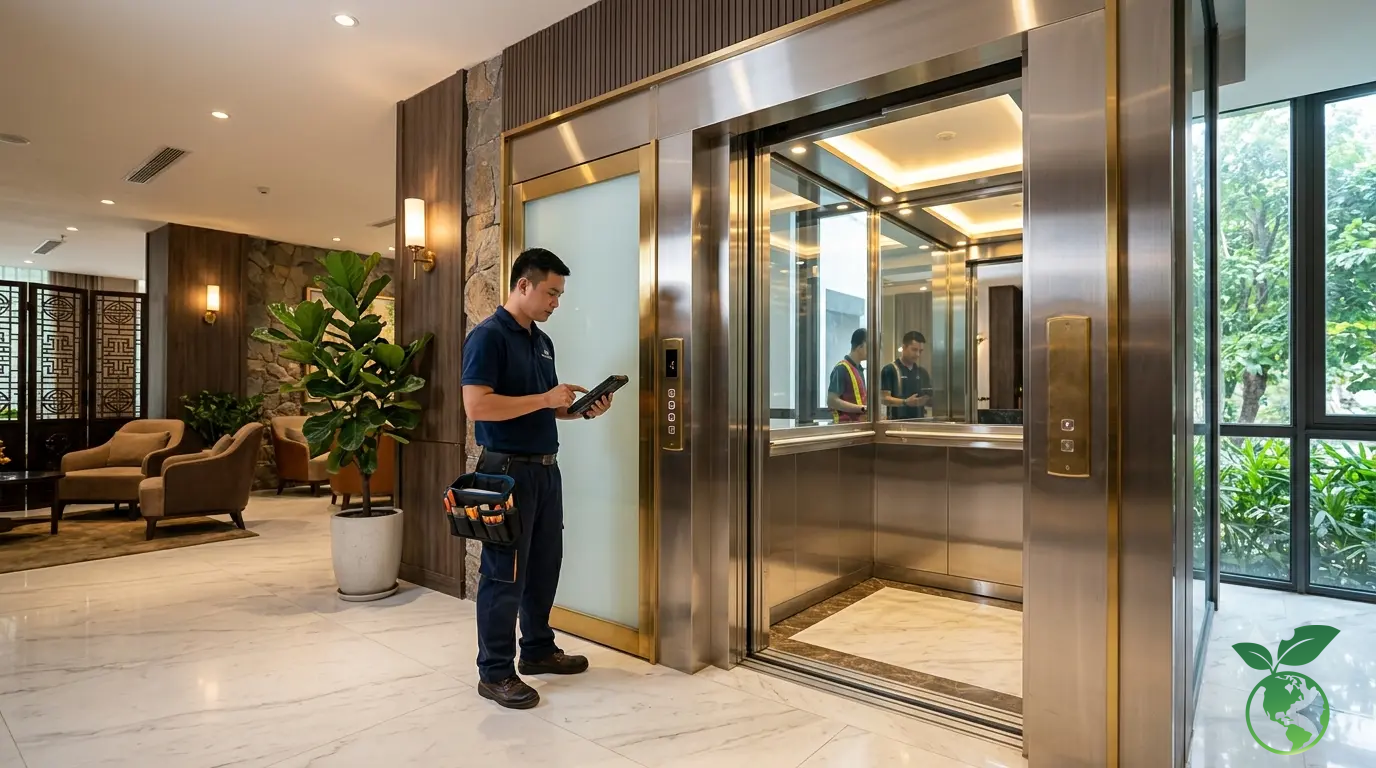
Errors detected during empty test runs: elevator jerking, misaligned floors, or slow door operation
Running empty helps identify basic travel and door faults. Jerking during startup may relate to inverter settings or brakes. Misalignment may relate to position signals. Slow doors usually need checking door rails, sensors, and closing force instead of replacing the motor immediately.
Errors detected when running with load: overcurrent during acceleration, deceleration, or steady running
Overcurrent errors appearing when loaded need to be considered seriously. Causes could be overloading, off-center loads, increased mechanical friction, or inappropriate inverter parameters. A warehouse in Long An uses a 500kg cabin to carry 470kg cargo bundles but stacked them towards the door. After standardizing the stacking position, the acceleration current dropped significantly.
Errors detected in the electrical system: overvoltage, phase loss, intermittent signals, or breaker tripping
Overvoltage, phase loss, or breaker tripping are not faults to operate through multiple times. Need to measure the source, check grounding, circuit breakers, terminals, and electrical load. When the power is unstable, inverters and contactors easily fail early. Periodic electrical inspection also supports compliance with current electrical safety requirements.
Errors detected in mechanical parts: worn cables, dry rails, poor brakes, or noisy pulleys
Cables with signs of wear, broken strands, or uneven pulley grooves need to be evaluated according to the manufacturer's technical criteria. Dry rails cause squeaking and increased friction. Poor brakes can make the cabin stop unstably. This group of faults needs professional technician assessment before deciding on replacement.
How to classify faults needing immediate repair, monitoring, and parts replacement
Faults affecting door locks, brakes, cables, power supply, or floor stopping need immediate repair. Slight noise faults can be monitored if the cause has been identified and a handling deadline has been set. Replace parts when parameters fall below technical thresholds, faults recur, or the cost of repairing multiple times is higher than replacing with new ones.
- Prioritize immediate repair of all faults related to door locks, brakes, hoisting cables, and power supply instability.
- Monitor with a deadline for slight noises that have identified causes and do not yet affect operation.
- Replace parts when faults recur after many adjustments or no longer meet technical specifications.
- Do not clear error codes before saving photos and recording the conditions under which they occurred to serve analysis.
- Compare empty and loaded data to distinguish mechanical faults from habits of stacking cargo.
| Fault group | Example | Priority | Decision |
|---|---|---|---|
| Safety | Door locks, brakes | Very high | Stop and repair immediately |
| Power supply | Phase loss, breaker trips | Very high | Measure and check source |
| Mechanical | Dry rails, noisy pulleys | Medium to high | Maintenance or replacement |
| Operation | Off-center cargo | Medium | Train users |
Practical tip: do not approve replacements just because “the part is old”. Require specific measurements, signs of wear, risks if continued to be used, and alternative replacement plans.
How is mini elevator maintenance and mini elevator repair different from cargo elevators?
Mini elevators usually serve families, townhouses, or small projects. The load, maneuvering space, and frequency differ from cargo elevators, but safety requirements are not reduced. Mini elevator maintenance needs to focus on user experience, smoothness, and narrow shaft space.
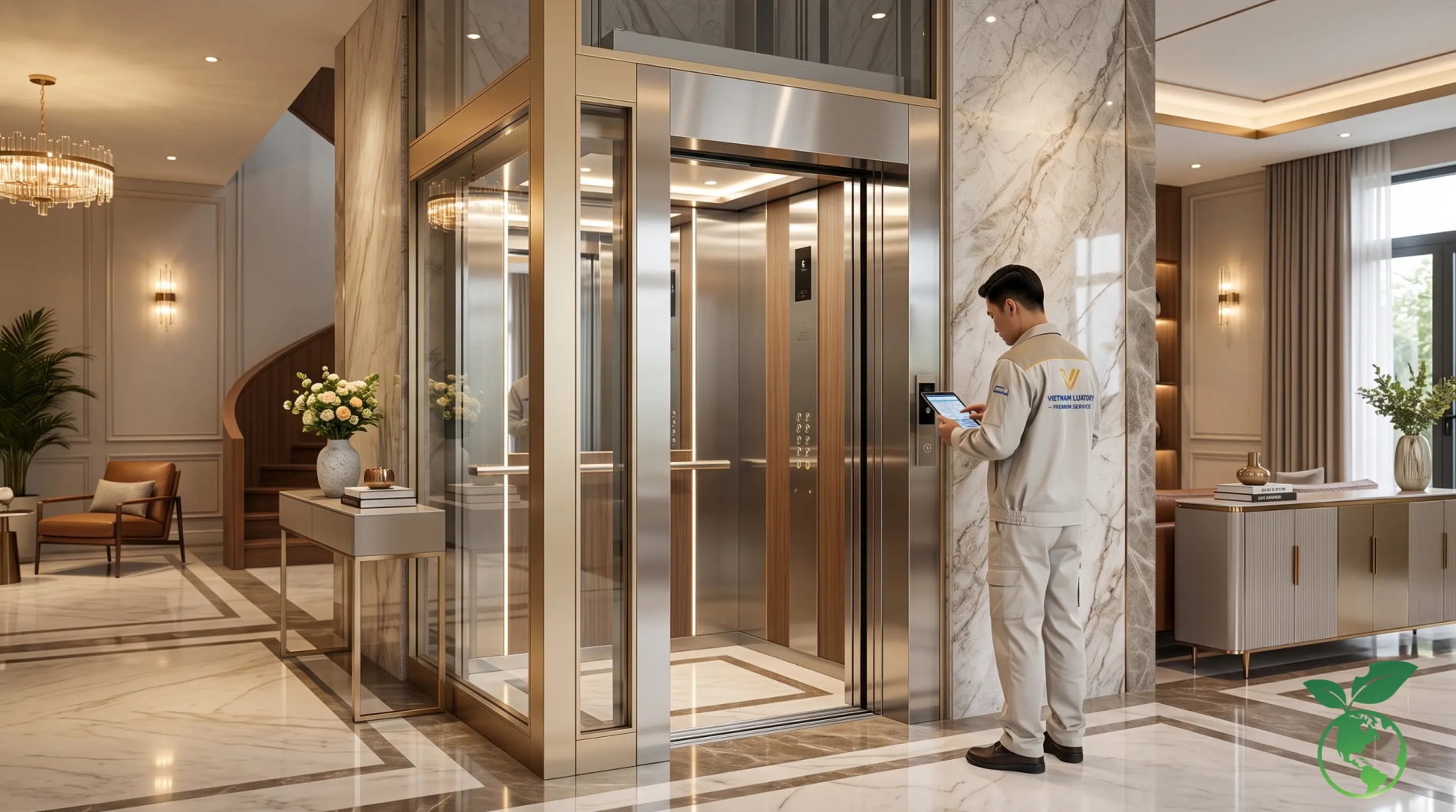
Items needing priority when maintaining mini elevators in townhouses and small projects
Prioritize checking cabin doors, landing doors, floor stopping, call signals, automatic rescue devices, and ventilation systems. Townhouses often have elevator shafts close to living areas, so noise and vibration directly affect daily life. Pitless elevator solutions needs careful inspection of the pit layout and area drainage.
Signs to repair mini elevators immediately to avoid affecting life and safety of use
Need to repair the mini elevator immediately when the door does not lock securely, the cabin stops misaligned, floor call panels lose signal, the elevator stops abnormally, or the rescue unit does not respond. For example, a townhouse in Hanoi has a 350kg elevator, four stops, shaft 1,350 x 1,450mm. Cleaning door rails and calibrating sensors helps reduce door reversal faults during family peak hours.
Differences in components, operating space, and technical requirements when repairing mini elevators
Small space requires better planning for repairs. Technicians must control shielding, access paths, and elevator downtime. Mini elevator components may differ in size, voltage, or configuration compared to cargo elevators. Do not replace with incompatible parts just because they are available.
When can you perform periodic mini elevator maintenance and when do you need to replace parts?
Bảo dưỡng định kỳ phù hợp khi lỗi chưa ảnh hưởng thiết bị an toàn và linh kiện vẫn trong giới hạn kỹ thuật. Cần thay khi cảm biến, khóa cửa, cáp, phanh hoặc ắc quy cứu hộ suy giảm rõ rệt. Theo các chuyên gia tại Thang Máy Việt Ý, nhà phố có người cao tuổi nên ưu tiên kiểm tra bộ cứu hộ và khả năng liên lạc trong cabin.
- Check floor leveling frequently because small deviations can cause tripping in townhouse spaces.
- Evaluate the automatic rescue unit periodically so the cabin can return to the nearest floor during a power outage.
- Clean door sensors and rails, especially for houses near dusty roads.
- Do not use non-configured replacement parts as they can cause prolonged signal errors.
- Check cabin ventilation and lighting to ensure daily usage experience.
| Criteria | Cargo Elevator | Mini Elevator | Maintenance Priority |
|---|---|---|---|
| Load capacity | High and fluctuating | Low, more stable | Overload control |
| Environment | Warehouse, kitchen, workshop | Townhouse, villa | Cleanliness, noise |
| Maneuvering space | Usually wider | Usually limited | Construction safety |
| Common faults | Doors, rails, overload | Doors, floor stopping, signals | Experience and safety |
Practical tip: with mini elevators, do not assess “less use means less maintenance”. Equipment that runs less can still degrade due to batteries, dust, moisture, and contact conditions.
What factors does cargo elevator maintenance cost depend on?
Costs cannot be evaluated only by the number of floors or load capacity. Reasonable quotations must reflect the type of transmission, number of stops, environment, number of runs, equipment age, on-call scope, and spare parts. Good cargo elevator maintenance needs transparency in periodic work and incidental parts.
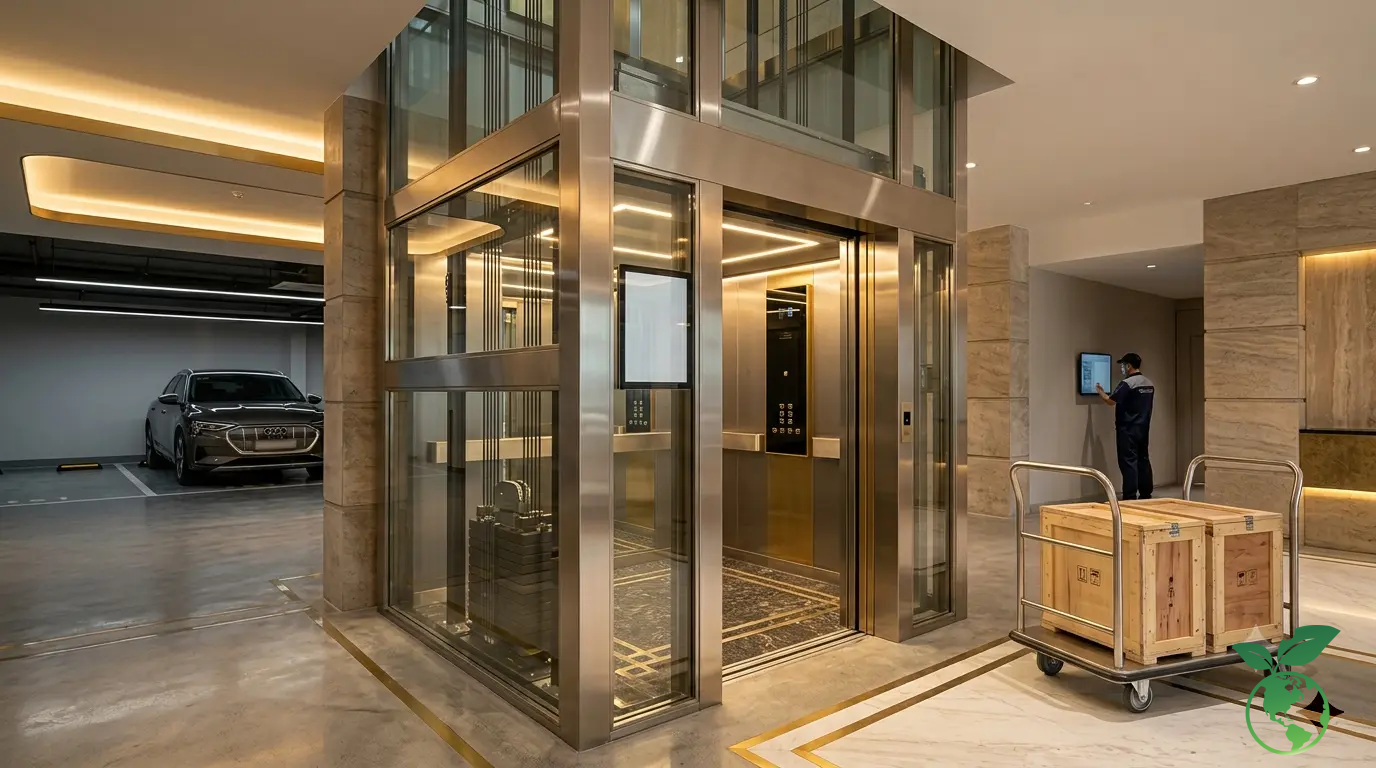
Costs by elevator type, load, number of stops, and actual usage level
Heavy-duty elevators, many floors, or continuous operation require more inspection time. Elevators using manual doors, automatic doors, cable traction, or hydraulics also have different items. Cheap contracts that skip brakes, cables, door locks, or load tests can create larger costs later.
Incidental costs when needing cargo elevator repair or replacing worn parts
Incidental costs usually come from sensors, contactors, door wheels, cables, pulleys, brakes, or inverters. Do not choose replacements based only on the lowest price. Check origin, compatibility, warranty conditions, and response time. Wrong configuration parts can make the elevator have recurring faults.
Compare monthly, quarterly, and annual maintenance contracts for businesses
Monthly contracts are suitable for dense operations. Quarterly contracts are suitable for light loads and stable environments. Annual contracts are often more effective when businesses need predictable budgets, but they must clearly record the number of inspections, incident response times, and exclusion lists.
How to read a maintenance quote to avoid missing important safety inspection items
The quotation needs to clearly show the scope of inspection, number of maintenance visits, list of excluded parts, incidental unit prices, response time, and reporting responsibilities. Buyers should ask: do you check brakes, cables, door locks, rescue units, and power supply? Do you report the condition of parts?
- Compare the scope of work before comparing prices to avoid choosing a contract with too narrow an inspection list.
- Request to clearly state the number of maintenance visits, response time, and after-hours incident response conditions.
- Separate periodic labor costs from parts costs to control the budget more transparently.
- Check the exclusion list, especially for inverters, hoisting cables, door locks, and rescue units.
- Evaluate downtime costs instead of just looking at the maintenance cost written on the quotation.
| Contract Type | Suitable for | Advantage | Points to clarify |
|---|---|---|---|
| Monthly | Continuously operating warehouse | Early Detection | Visits and incident response |
| Quarterly | Light-duty lift | Costs more compact | Conditions for shortening cycle |
| By year | Businesses with many devices | Easy to budget | Excluded parts |
| Ad-hoc repair | Single fault | Short-term flexibility | Risk of no historical data |
Practical tip: ask the maintenance provider to present costs by “prevention”, “correction”, and “replacement”. This separation helps management clearly see which items can be predicted and which are risks.
What should be done after maintenance to manage risks and optimize operating costs?
Completing maintenance does not mean the work ends. The value of cargo elevator maintenance lies in the data after handover: which faults were handled, which are being monitored, which parts should be provisioned, and who is responsible for responding when an incident occurs.
Check the maintenance report immediately after the technician hands over the project
The person in charge should read the report on the spot. The report needs to record the elevator serial number, time, inspection items, state before/after, replaced parts, and remaining faults. Do not sign just because the cabin has made one run. Compare with previously reported faults.
Save maintenance files, repair history, and replacement recommendations for inspection
Complete records support the inspection process and investment decision-making. The list of inspection organizations is announced by management agencies, so owners should use units with suitable operational conditions.
Track recurring faults to decide on repairs, overhauls, or elevator upgrades
Recurring door faults, unstable floor stopping, or repeated inverter overheating are signals that deep evaluation is needed. Not every recurring fault needs an overhaul. However, when individual repair costs increase and downtime affects operations, businesses should compare upgrade options with continuing to patch faults.
Establish an incident response point of contact to reduce elevator downtime during operation
Every project needs a point of contact who knows the elevator serial number, control cabinet location, fault history, and technical contact number. This person does not repair the equipment themselves. The main role is to isolate the area, send correct information, and confirm the current state. Clear response procedures help reduce diagnostic time when incidents occur.
- Read the report on-site and ask to supplement items that are recorded too generally or lack results.
- Save fault history by elevator code to avoid confusing data between multiple devices.
- Set clear completion deadlines for all parts replacement recommendations with safety risks.
- Analyze recurring faults by month to decide on reasonable repairs, overhauls, or upgrades.
- Designate a response point of contact authorized to stop the elevator when dangerous faults appear.
| Post-maintenance documents | Purpose | Holder | Time to review |
|---|---|---|---|
| Maintenance report | Work confirmation | Project management | Right after handover |
| Error log | Repeated analysis | Operation | Monthly |
| Replacement list | Budget estimation | Finance and technical | Quarterly |
| Inspection records | Compliance proof | Owner | According to inspection cycle |
Conclusion: Effective cargo elevator maintenance starts with early identification and ends with data governance. Remember the following points:
- Do not wait for the elevator to stop completely before checking vibration, noise, landing doors, or leveling deviations.
- Schedule by number of runs, load, and environment instead of applying a fixed cycle.
- Require an inspection process with surveys, mechanics, electronics, test runs, and a clear handover report.
- Classify faults by safety level to know when to stop the machine and call for emergency repair.
- Read quotations by scope, response time, and exclusion items, not just by low price.
- Save records to serve inspection, replacement estimation, and identification of recurring faults over time.
Với biệt thự, nhà phố, khách sạn và kho xưởng, Thang Máy Việt Ý là đối tác cung cấp, lắp đặt và bảo trì phù hợp khi chủ đầu tư cần quy trình kỹ thuật rõ ràng, kiểm soát an toàn và định hướng nâng cấp lâu dài. Hãy ưu tiên đánh giá hiện trạng trước, rồi mới quyết định sửa chữa hay thay thế.